Recovering the Irretrievable: The Fraught Science of Reconstructing Lost Indian Classical Dance
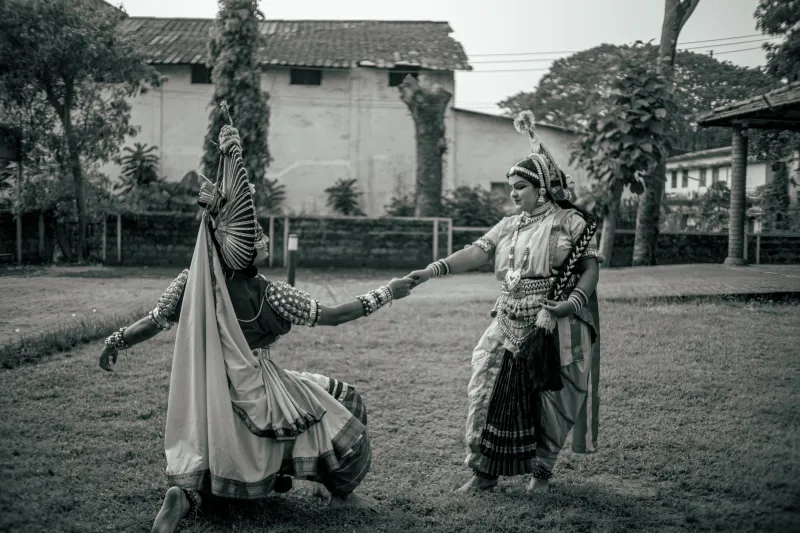
In the spring of 2019, a senior Odissi scholar based in Bhubaneswar sat across from a ninety-one-year-old former devadasi, recording her recollections of a particular pallavi sequence she had performed in the 1940s. The scholar had spent three years tracking down this woman through a chain of oral referrals. The recording lasted forty minutes. The dancer's memory was precise about the emotional arc of the piece but vague about the precise footwork patterns in its second section. She died four months later.
That recording now sits in a digital archive—incomplete, irreplaceable, and hotly contested among the scholars who have since attempted to use it as the foundation for a stage reconstruction. The disagreement is not merely academic. It touches something fundamental about the nature of classical Indian dance: a tradition that was, for most of its history, never meant to be written down at all.
The Oral Body as Archive
Western performing arts have long relied on notation systems—Labanotation, Benesh Movement Notation, printed scores—to preserve choreographic works across generations. Indian classical dance developed no equivalent infrastructure, and for reasons that were not accidental. The guru-shishya parampara, the lineage-based transmission from teacher to student, was itself the archive. The living body was the medium of record.
This was not a failure of sophistication. It was a deliberate epistemology. Movement knowledge passed through physical demonstration, through years of embodied repetition, through the subtle corrections of a teacher's hand repositioning a student's wrist. The tradition assumed continuity of human transmission. What it did not anticipate was rupture.
Rupture arrived in several historical waves. British colonial policies in the nineteenth and early twentieth centuries criminalized the devadasi communities who had been the primary custodians of many temple dance traditions. The Devadasi Abolition Act of 1947 in Tamil Nadu, well-intentioned as social reform, effectively severed institutional lineages that had sustained Bharatanatyam for centuries. Partition displaced performers and fractured regional schools of Kathak. Decades of underfunding drove younger generations away from the arts. The result, by the mid-twentieth century, was a landscape of missing links—traditions that had survived in attenuated form, with critical sections lost, disputed, or existing only in the unreliable custody of individual memory.
The Detective Work of Reconstruction
When institutions today attempt to recover these lost choreographies, the process resembles forensic archaeology more than artistic revival. Scholars cross-reference colonial-era photographs, temple sculpture iconography, fragmentary European traveler accounts, and the competing testimonies of elderly practitioners. Each source carries its own distortions.
Photographs freeze a single moment and flatten spatial information. Temple sculptures capture idealized postures but cannot convey rhythm or sequence. European accounts were filtered through observers who often misunderstood what they were watching. And oral memory, however vivid, is subject to the well-documented human tendency to unconsciously revise the past through the lens of the present.
The scholar Sunil Kothari, whose decades of documentation work on Odissi and other classical forms produced some of the most significant archival records in the field, frequently warned that reconstruction is always interpretation. Every choice a reconstructing dancer makes—about tempo, about the precise angle of a mudra, about which of two contradictory oral accounts to trust—is an editorial act. The result is not recovery. It is, at best, a plausible hypothesis.
This creates an uncomfortable situation for institutions that present reconstructed works to audiences. American presenters, in particular, often market these pieces with language suggesting historical authenticity—"a work from the seventeenth century, revived for the first time in three hundred years." The framing sells tickets. It also misleads audiences about what they are actually witnessing.
The Fidelity Question
Among practitioners and scholars, the debate over fidelity has grown sharper as reconstruction projects have multiplied. One school of thought holds that the goal of reconstruction must be maximum fidelity to whatever evidence survives—that even an imperfect recovery is more valuable than invention, and that scholarly rigor demands transparency about the gaps. Under this view, a reconstructed piece should be presented with detailed documentation of its sources and acknowledged lacunae, much as a critical edition of a literary text would note variant readings and missing passages.
A second school argues that this approach fundamentally misunderstands how living traditions function. Classical Indian dance was never a fixed text. It evolved continuously through the creative contributions of successive generations of performers. The devadasi who performed a varnam in 1890 was not executing an unchanged choreography from 1750; she was performing her teacher's version of her teacher's version of something older, each iteration shaped by individual artistry and contemporary context. To fetishize fidelity to a fragmentary record is, on this view, to mistake the tradition's surface for its substance.
This second position has significant implications. It suggests that a skilled contemporary choreographer reconstructing a lost work is not merely filling gaps—she is continuing the tradition in the only way the tradition was ever actually sustained: through living creative intelligence. The reconstruction becomes a new work in dialogue with the past, rather than a failed attempt to recover something irretrievably gone.
Living Memory and Its Limits
The urgency of this debate is intensified by demographics. The generation of performers who trained before the major institutional disruptions of the mid-twentieth century is nearly gone. Organizations like the Sangeet Natak Akademi in India and diaspora institutions in the United States have accelerated their oral history programs, but funding remains inadequate and the work is slow. A single extended interview with a knowledgeable elder can require months of preparation to be analytically useful.
Some American universities with South Asian studies programs have begun collaborating with Indian institutions on digital archival projects, using motion capture technology to record the movement vocabularies of senior practitioners in granular detail. These efforts are valuable, but they document what exists now—not what was lost before the cameras arrived.
For the dance companies attempting to stage reconstructions, the practical pressures are acute. Funders want premieres. Audiences want spectacle. The slow, uncertain work of scholarly reconstruction does not naturally produce either. The result is often a compression of the research phase, with artistic decisions made under time pressure that would benefit from years of additional study.
What Audiences Deserve to Know
Perhaps the most constructive shift would be a change in how reconstructed works are framed for American audiences—audiences who, in many cases, lack the cultural context to interrogate such claims independently. Program notes that honestly describe the reconstructive process, that name the sources consulted and the choices made, would serve both intellectual honesty and educational purpose. They would also, arguably, make the work more interesting: the story of how a dance was recovered from a forty-minute recording and a set of temple carvings is itself a compelling narrative.
The tradition that the Natyasastra documents was always understood as a living system, responsive to time and place. The challenge facing contemporary institutions is not to pretend that living systems can be perfectly frozen and thawed. It is to honor what can be recovered while being honest about what reconstruction actually is: an act of creative scholarship, shaped by the present as much as by the past—and no less valuable for that.


