Body as Text: How Broadway's Most Ambitious Performers Are Mining Indian Classical Dance for a Deeper Acting Language
For decades, the dominant vocabulary of serious American actor training has drawn from a familiar constellation of sources: Stanislavski's emotional memory, Meisner's moment-to-moment responsiveness, Viewpoints, Laban Movement Analysis. These methodologies have produced generations of accomplished performers. Yet an increasing number of Broadway actors, movement directors, and conservatory educators are arriving at an unexpected supplement to that canon — one that originates not in the studios of Moscow or New York, but in the temple courtyards and hereditary lineages of classical India.
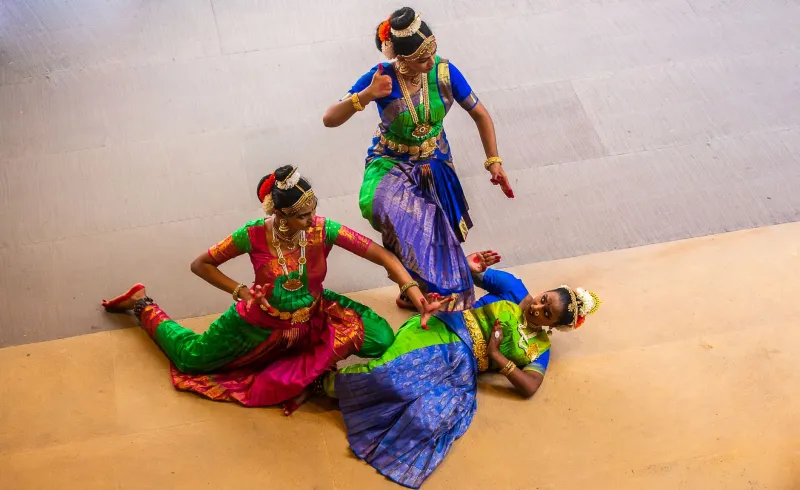
Bharatanatyam and Kathak, two of India's most technically demanding classical dance forms, are entering the American theatrical mainstream not as aesthetic curiosities but as rigorous performance technologies. The practitioners bringing them into rehearsal rooms and training curricula argue that these traditions contain solutions to problems that Western actor training has long circled without fully resolving: the precise coordination of inner emotional state and outward physical expression, the discipline of sustained presence, and the capacity to communicate layered meaning without the crutch of spoken language.
The Problem That Classical Indian Dance Solves
Ask a working Broadway actor what separates a technically accomplished performance from a genuinely transformative one, and the answers tend to orbit a common center. It is not simply feeling the emotion — most trained actors can access emotional states reliably. The challenge is transmitting that state through the body with sufficient precision and intentionality that an audience member in the back row of a 1,500-seat house receives it as a coherent, specific experience.
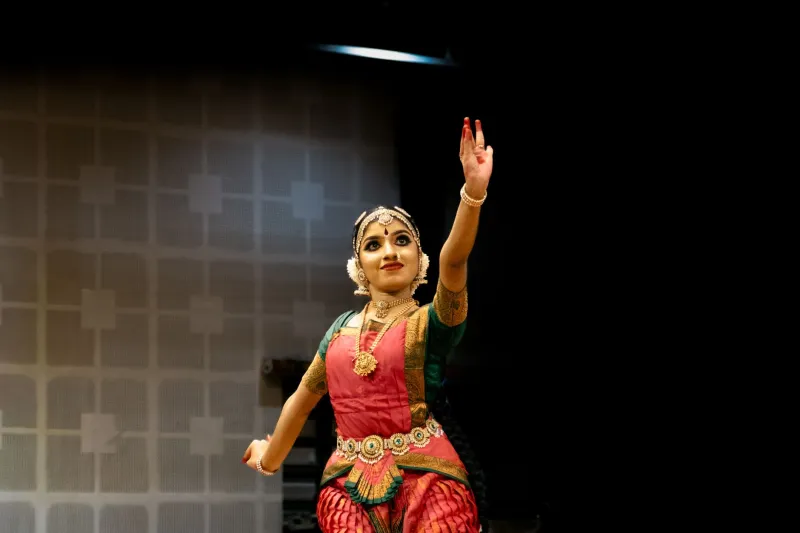
This is precisely the territory that the classical Indian performance tradition addresses with extraordinary sophistication. At the heart of Bharatanatyam's expressive system is abhinaya — a fourfold framework of communication encompassing the body (angika), speech and sound (vachika), costume and ornamentation (aharya), and interior emotional state (sattvika). The tradition does not treat these as separate channels that a performer manages simultaneously; it trains them as a unified instrument through years of disciplined practice.
For Western actors accustomed to prioritizing psychological interiority, the encounter with angika abhinaya — the codified use of the entire body as expressive text — is frequently described as both humbling and revelatory. The tradition demands an anatomical specificity that most Western movement training approaches only approximately: the precise articulation of each finger joint, the differentiated use of the eyes and eyebrows as independent expressive instruments, the calibrated relationship between breath and rhythmic pulse.
From the Studio to the Stage
Nadia Vasquez, a movement director whose credits include several off-Broadway productions that have subsequently transferred to larger houses, began studying Kathak in her late twenties after a colleague recommended it as a complement to her existing Laban training. What she encountered, she has said in interviews with performing arts educators, was less a dance form than a complete epistemology of physical expression.
"Kathak gave me a language for something I had always intuited but couldn't systematize," she has explained. "The way the tradition trains you to inhabit rhythm — not just respond to it, but let it organize your entire nervous system — changed how I approach scene work with actors. Rhythm isn't just a musical property. It's a structural principle of human attention."
Vasquez now incorporates Kathak-derived exercises into her rehearsal process, particularly during early table-work phases when actors are mapping the emotional architecture of their characters. She is careful to distinguish between borrowing specific movement vocabularies — which she considers both culturally presumptuous and pedagogically shallow — and extracting the underlying principles of body-mind integration that the tradition has refined over centuries.
This distinction matters. The goal is not to produce Broadway actors who perform Indian classical dance, nor to strip those traditions of their cultural and spiritual contexts for the convenience of American theatrical production. The goal, as practitioners in this space consistently emphasize, is to allow the depth of one tradition to illuminate and expand the capacities of another.
Rasa Theory as Emotional Architecture
Perhaps the most intellectually substantive contribution that Indian classical performance theory makes to Western actor training is the concept of rasa — the aesthetic emotional essences that a skilled performer cultivates and transmits, and that an audience member receives and experiences as heightened feeling. The Natyashastra, the ancient Sanskrit treatise on performance from which this publication takes its name, identifies eight primary rasas: love, humor, sorrow, fury, heroism, terror, disgust, and wonder, with devotion sometimes added as a ninth.
What distinguishes rasa theory from Western models of emotional performance is its orientation toward the audience's experience rather than the performer's internal state. A performer does not simply feel grief; they craft the conditions under which an audience experiences karuna, the rasa of compassion and sorrow. This subtle but profound reorientation — from expression to transmission — has proven genuinely useful to American actors grappling with the demands of large-format theatrical performance.
Marco Delgado, an actor with extensive Broadway credits in both dramatic and musical theater, began working with a Bharatanatyam teacher after a director suggested that his emotional performances were not consistently landing beyond the first several rows of the orchestra. The feedback was precise and difficult to argue with. What he found in his initial months of study was that the Indian classical tradition had already theorized and solved this exact problem.
"The tradition assumes that the performer's job is to create an experience in another person," he has said. "That sounds obvious, but it completely reorganizes your priorities in rehearsal. You stop asking 'am I feeling this?' and start asking 'is this landing?' Those are very different questions."
The Question of Lineage and Attribution
Any serious engagement with this phenomenon must acknowledge the complex questions of cultural exchange that it raises. Indian classical dance forms are not neutral technical resources available for extraction by Western performers seeking competitive advantages. They are living traditions embedded in specific histories, communities, and spiritual frameworks — traditions that have survived colonial suppression and cultural marginalization in part through the fierce guardianship of their practitioners.
The movement coaches and actors who engage most thoughtfully with this territory are explicit about the importance of formal study under qualified teachers, of financial compensation that flows back to communities of origin, and of public acknowledgment of the traditions being drawn upon. Several have established ongoing mentorship relationships with senior Indian classical dance artists, treating the exchange as a genuine dialogue rather than a one-directional extraction.
The Natyashastra itself, composed likely between 200 BCE and 200 CE, was conceived as a comprehensive guide to performance in its fullest sense — encompassing not only technique but ethics, community, and the relationship between performer and audience as a fundamentally sacred transaction. That Broadway's most thoughtful practitioners are finding their way back to these questions, through the discipline of the body rather than the discourse of the seminar room, may be among the more quietly significant developments in contemporary American theater.
What the Tradition Offers That Cannot Be Rushed
There is a final irony worth noting. The aspects of Indian classical dance training that Broadway performers find most transformative are also precisely those that cannot be acquired quickly. The anatomical precision of angika abhinaya requires years of daily practice to internalize. The capacity to sustain sattvika — the quality of authentic interior emotional presence — is developed through a relationship with the tradition that unfolds across decades, not workshops.
In an American theatrical economy that moves quickly and demands immediate results, this is a genuinely countercultural proposition. The performers and coaches who have committed to it describe the experience not as supplementing their existing training but as deepening their understanding of what training itself is — a lifelong practice of refinement, not a credential to be acquired and deployed.
That understanding, too, is something the Natyashastra anticipated. The text is not a manual for the impatient. It is an invitation to a lifetime of serious attention to the craft of making human beings feel, together, in a shared space. Broadway, at its best, has always wanted to do exactly that.