Something Ancient Is Speaking: The Inexplicable Emotional Power of Rasa in Performance
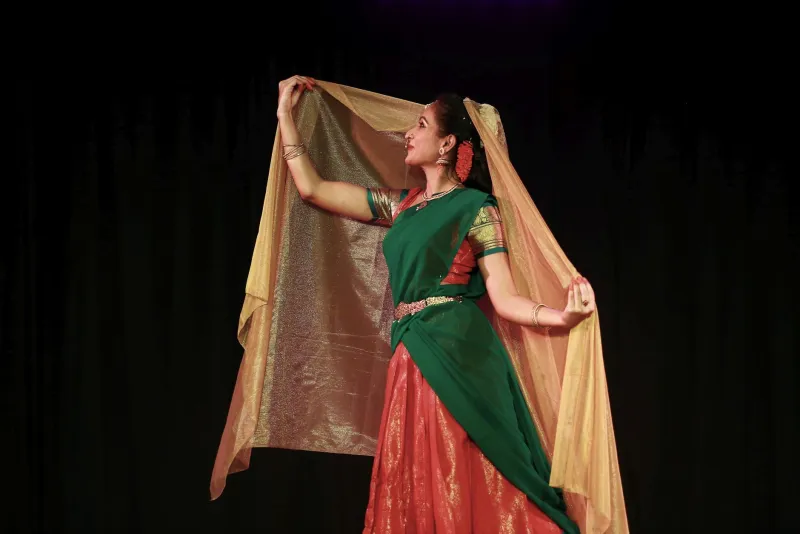
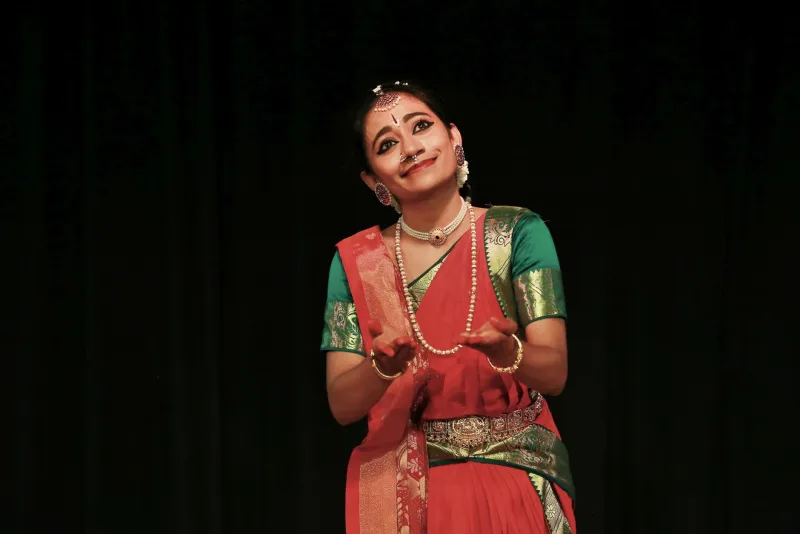
Sarah Okonkwo had never seen a Bharatanatyam performance before the evening she attended a showcase at the Asia Society in New York City. She arrived, by her own admission, out of mild curiosity and a friend's insistence. She left, she says, having wept without fully understanding why.
"I couldn't tell you what the story was," she recalls. "I didn't know the gestures. I didn't know the music. But something was happening in that theater that I couldn't explain away. It felt like being addressed directly — like whatever that dancer was doing, it already knew me."
Okonkwo's experience is neither unusual nor anecdotal in isolation. Across the United States, as Indian classical dance forms such as Bharatanatyam, Odissi, Kathak, and Manipuri reach wider audiences through university stages, arts festivals, and touring productions, a consistent and curious phenomenon is being reported: audiences who lack any prior exposure to the tradition describe emotional responses of striking depth and specificity. Grief, exaltation, stillness, longing — arriving uninvited and departing slowly.
The question this raises is not merely aesthetic. It is, at its core, philosophical. And it is one that the ancient Indian treatise on the performing arts, the Natyashastra, addressed with remarkable sophistication nearly two millennia ago.
What Rasa Actually Means
The term rasa — often translated as "flavor" or "essence" — is the central organizing concept of classical Indian aesthetic theory. Attributed to the sage Bharata Muni, the Natyashastra describes eight primary rasas, later expanded to nine by the philosopher Abhinavagupta in the tenth century: shringara (love), hasya (joy), karuna (compassion), raudra (fury), vira (heroism), bhayanaka (terror), bibhatsa (disgust), adbhuta (wonder), and shanta (tranquility).
Crucially, rasa is not simply emotion. It is the aesthetic experience of emotion — emotion refined, elevated, and universalized through the vehicle of skilled performance. The dancer does not merely feel sorrow; she transmutes personal feeling into a communicable essence that the audience can taste, as one might taste the complexity of a fine dish without knowing every ingredient.
Abhinavagupta's contribution was particularly significant. He argued that rasa is not generated in the performer, nor simply received by the audience, but arises in the space between them — in a kind of shared, temporarily boundless consciousness he called sadharanikarana, or "universalization." The audience member, for the duration of the performance, is released from the constraints of their individual ego and enters a state where another's emotion becomes, experientially, their own.
This is a bold claim. It is also, increasingly, one that neuroscience is finding difficult to dismiss.
What the Brain Appears to Confirm
Researchers studying aesthetic emotional response have, in recent decades, documented the existence of what some call "aesthetic chills" — involuntary physiological responses to art that include goosebumps, tears, and altered heart rate. These responses are not culturally bounded in the ways we might expect. Studies examining cross-cultural emotional recognition in music and movement have repeatedly found that certain expressive qualities communicate affect across populations with no shared cultural history.
Dr. Anand Krishnamurthy, a cognitive neuroscientist at the University of Michigan who has studied emotional processing in arts audiences, describes the phenomenon in terms of what he calls "embodied resonance." "When we observe another body in motion," he explains, "our mirror neuron systems are activated. We are, in a very literal neurological sense, simulating the movement we witness. If that movement is organized around the expression of a coherent emotional state — particularly one expressed through the face, hands, and posture simultaneously, as in classical Indian dance — the simulation becomes remarkably rich."
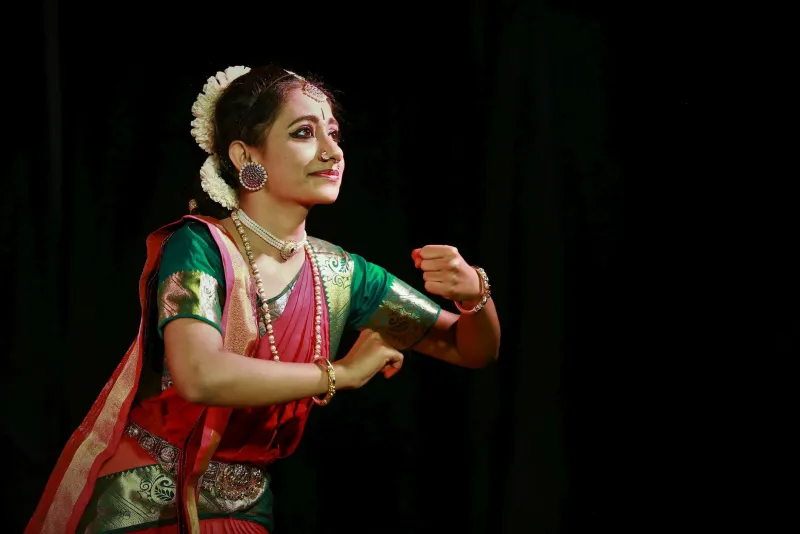
What makes Indian classical dance a particularly potent case, Krishnamurthy suggests, is the extraordinary precision of its expressive vocabulary. The ashtanayika (eight types of heroine), the twenty-seven hastas (hand gestures) of the Natyashastra, the codified eye movements, the postural alignment — these are not decorative conventions. They are, in the framework of rasa theory, a rigorously engineered delivery system for emotional transmission.
"The grammar is extraordinarily specific," says Madhavi Raghunathan, a senior Bharatanatyam performer and faculty member at the Cleveland-based Nritya Kala Academy. "Every angle of the wrist, every shift in the gaze, every accent of the foot has been calibrated over centuries to produce a precise emotional effect. When it is executed with full understanding and full presence, the communication is almost impossible to block."
The Paradox at the Heart of the Experience
And yet the paradox remains. If rasa theory is a culturally specific system — developed within a particular philosophical and religious tradition, encoded in Sanskrit texts, transmitted through lineages of practice rooted in South Asian life — why does it appear to operate on audiences who have no access to that tradition?
Part of the answer may lie in what the tradition itself claims. The Natyashastra does not frame the rasas as culturally particular. It frames them as the fundamental emotional architecture of human experience — the nine irreducible flavors of what it means to be alive in a body, in relationship, in time. The specific narrative vehicle (a story from the Mahabharata, a devotional poem to Krishna) is the occasion, not the substance. The substance is the emotion itself, rendered in its purest form.
This is a claim that resonates with certain strands of Western aesthetic theory as well. When the philosopher Susanne Langer argued that art presents "the morphology of feeling" in forms that are apprehensible across individual differences, she was reaching toward something structurally similar to what Abhinavagupta described a thousand years earlier.
"What I tell my students," says Raghunathan, "is that the narrative is a door. You don't need to walk through the door to feel the warmth on the other side. The rasa is the warmth. It is already there, waiting."
What American Audiences Are Beginning to Discover
For many Americans encountering Indian classical dance for the first time, the experience challenges assumptions about cultural accessibility that run deep in contemporary arts discourse. We have been taught, with some reason, that art is culturally embedded — that meaning depends on context, that appreciation requires education. This is not false. But the testimony of audiences like Sarah Okonkwo suggests that it is incomplete.
There is, it appears, a layer of performance that precedes cultural literacy. A layer at which the body speaks directly to the body, at which the face speaks directly to the face, at which something ancient and shared surfaces in the space between stage and seat.
The Natyashastra called this the arising of rasa. Neuroscience is beginning to map its contours. And American audiences, arriving at theaters without a roadmap, are discovering it one inexplicable evening at a time.
What Bharata Muni understood — and what contemporary performers carry forward in every performance — is that the deepest function of the performing arts is not to entertain, nor even to instruct, but to remind. To remind the audience, through the disciplined body of the performer, of what it already knows about grief and joy and longing and wonder. The cultural specificity of the form is real. But beneath it runs something older, something that does not require translation.
Something, as Okonkwo put it, that already knows you.