When Ancient Wisdom Meets the fMRI Machine: Science Catches Up to Rasa Theory
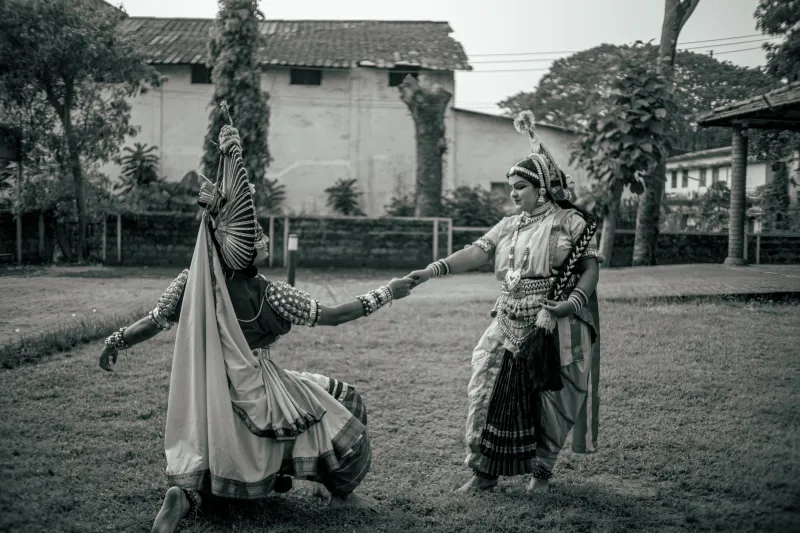
Somewhere between a Bharatanatyam dancer's arched eyebrow and the gasp of an audience member seated three rows back, something measurable occurs. It has always occurred. The Natyashastra — that encyclopedic treatise on performing arts composed roughly two thousand years ago — described it with extraordinary precision, cataloging eight primary emotional states, the physical gestures that evoke them, and the conditions under which a viewer enters a state of aesthetic absorption so complete that the self momentarily dissolves. Ancient scholars called this absorption rasa. Western academic institutions, for most of the twentieth century, called it subjectivity.
They are calling it something else now.
The Problem With Dismissing What You Cannot Yet Measure
For decades, the scholarly conversation around rasa theory in American universities followed a familiar arc. Comparative literature departments might acknowledge the Natyashastra's historical significance. Ethnomusicologists would note its influence on performance practice. But the core claim — that specific, codified aesthetic experiences could be reliably induced and reliably received through trained performance — was treated as philosophical rather than empirical. The implicit assumption was that emotion in performance was too variable, too culturally contingent, too subjective to submit to rigorous scientific scrutiny.
This assumption is now under considerable pressure.
Over the past decade, a loosely affiliated network of researchers across neuroscience, cognitive psychology, and affective science has begun applying contemporary measurement tools to questions that the Natyashastra addressed with remarkable specificity. The results have been, depending on whom you ask, either surprising or entirely expected.
What the Scanners Are Revealing
Functional MRI studies examining audience responses to classical Indian dance performances have identified consistent patterns of neural activation during moments that trained performers would classify as peak rasa transmission. Regions associated with emotional processing, mirror neuron activity, and what researchers describe as "embodied simulation" — the brain's tendency to internally rehearse observed movement — light up in ways that correlate with the viewer's self-reported emotional experience.
More striking still is the consistency across culturally divergent test populations. In studies conducted at institutions including the University of California system and several European research centers, audiences with no prior exposure to classical Indian dance demonstrated measurable affective responses to specific facial expressions — the navarasas or nine emotional states — at rates significantly above chance. The abhinaya, or expressive facial vocabulary, that Bharatanatyam and Odissi dancers spend years refining appears to operate on perceptual channels that precede cultural conditioning.
Biometric research has added further texture to these findings. Galvanic skin response measurements, heart rate variability analysis, and pupillometry — the tracking of involuntary pupil dilation — have all been deployed in performance contexts to map the physiological correlates of aesthetic experience. Researchers at institutions studying cross-cultural emotional recognition have found that the micro-expressions trained Indian classical dancers deploy with deliberate precision trigger autonomic nervous system responses in observers that align with the emotional category the performer intended to convey.
In other words: the transmission is real. It is measurable. And it appears to function with a reliability that the Natyashastra's authors would have considered entirely unremarkable.
The Dancer's Perspective on Being Proven Right
Practitioners of classical Indian dance forms have responded to this emerging body of research with a mixture of gratification and gentle exasperation. Senior Bharatanatyam artists and scholars have noted, with some frequency, that the validation offered by neuroscience confirms what students in the guru-shishya tradition have understood through direct experience for generations. The rigorous technical training demanded by these forms — years spent perfecting the precise angle of a glance, the specific tension of a hand position, the relationship between breath and emotional state — was never arbitrary aesthetic preference. It was, in the understanding of the tradition, the systematic cultivation of a communicative technology.
For American audiences encountering this research, the reframing it offers is significant. Classical Indian dance has too often been received in the United States as beautiful but opaque — visually striking, culturally remote, and requiring extensive contextual knowledge to appreciate meaningfully. The neuroscientific literature complicates this perception in productive ways. It suggests that the art form's communicative power operates partly through channels that are universal and immediate, not exclusively through channels that require cultural initiation.
Rasa Theory as a Framework for Affective Science
Perhaps the most consequential development in this emerging intersection is not the validation of specific findings but the growing recognition among researchers that rasa theory itself constitutes a sophisticated theoretical framework worthy of serious engagement.
The Natyashastra's taxonomy of emotional states, its analysis of the conditions that facilitate or impede aesthetic absorption, and its attention to the relationship between performer intention and audience reception anticipate concerns that occupy contemporary affective science. Researchers studying emotional contagion, embodied cognition, and the neuroscience of aesthetic experience are, in some cases, beginning to engage with classical Indian performance theory not merely as a cultural artifact but as a body of knowledge that has something to contribute to the discipline.
This represents a meaningful shift. The movement is from treating rasa theory as an object of study — something Western science examines from the outside — to treating it as a potential interlocutor, a tradition of inquiry that has generated insights Western frameworks are only now approaching.
What This Means for American Audiences and Institutions
For performing arts presenters, educators, and cultural institutions across the United States, the scientific legitimacy now accruing to rasa theory carries practical implications. Arts education programs that have struggled to articulate the intellectual rigor underlying classical Indian dance training now have a body of empirical literature to draw upon. Presenters introducing these forms to American audiences unfamiliar with the tradition have new language available for framing the experience — language that speaks to curiosity about the science of emotion and attention, not only to interest in cultural diversity.
There is also a more fundamental reorientation at stake. The assumption that Western scientific frameworks represent the appropriate standard against which non-Western knowledge systems must seek validation is itself a premise worth examining. That the Natyashastra's account of emotional transmission has proven empirically defensible is significant. That it required fMRI confirmation to be taken seriously by certain institutional contexts is, perhaps, equally revealing.
The dancers knew. The tradition recorded what it knew with meticulous care. The laboratory is now, somewhat belatedly, catching up — and the conversation that follows promises to be one of the more genuinely illuminating exchanges between ancient performance knowledge and contemporary science that the field of performing arts has witnessed in some time.