Built for Intimacy: Why Indian Classical Dance Loses Something Essential When the Stage Gets Too Large
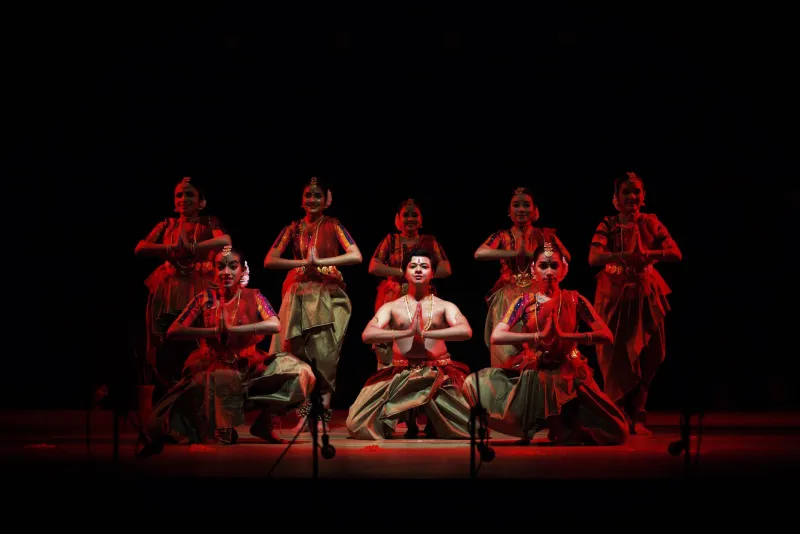
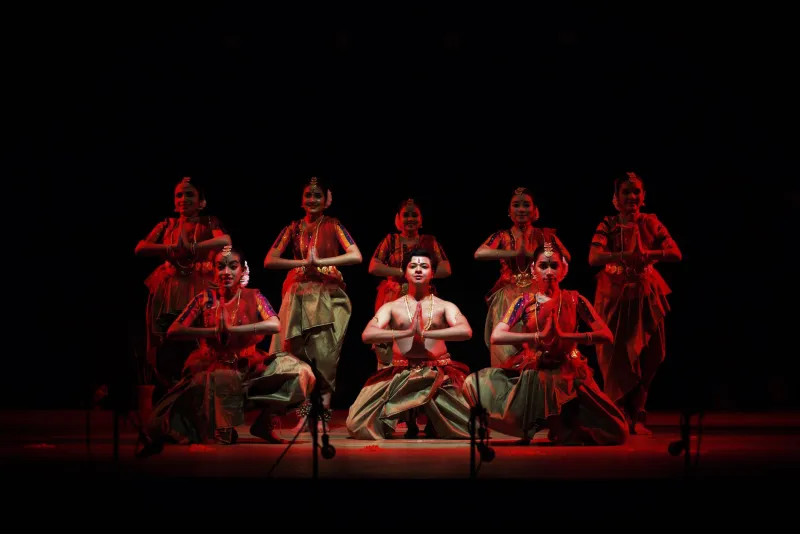
In the spring of 2023, a celebrated Bharatanatyam soloist performed at a mid-sized performing arts center in the American Midwest. The house held roughly eighteen hundred seats. The dancer was accomplished, the lighting carefully designed, the sound system impeccable. And yet, by most accounts of those who attended, something was missing — something that those same audience members had felt, unmistakably, at a smaller recital the previous year held in a university black-box theater seating perhaps two hundred.
What was absent was not technical skill. It was proximity. It was the sense, almost physiological, of being inside the art rather than observing it from across a field.
This experience is neither anecdotal nor accidental. It points toward a structural and philosophical tension that Indian classical dance has carried, largely unexamined, since its migration into Western theatrical contexts: these forms were not designed for large rooms.
Architecture as Argument
The spatial origins of Indian classical dance are inseparable from its meaning. Bharatanatyam, Odissi, Manipuri, Kuchipudi — each emerged within architectural environments that were modest by contemporary concert standards. Temple mandapas, royal darbars, and domestic courtyards defined the proportional relationship between performer and witness for centuries. The Natyasastra itself, the foundational Sanskrit treatise on dramaturgy and performance from which this publication draws its name, is remarkably specific about theater construction. It describes ideal playhouses as compact, enclosed, and calibrated so that even whispered speech and subtle facial expression could reach every seat.
This was not aesthetic preference. It was epistemological design. Indian classical performance is built around the transmission of rasa — the distilled emotional essence that arises between a skilled performer and an attentive audience. That transmission depends on legibility. And legibility depends on distance.
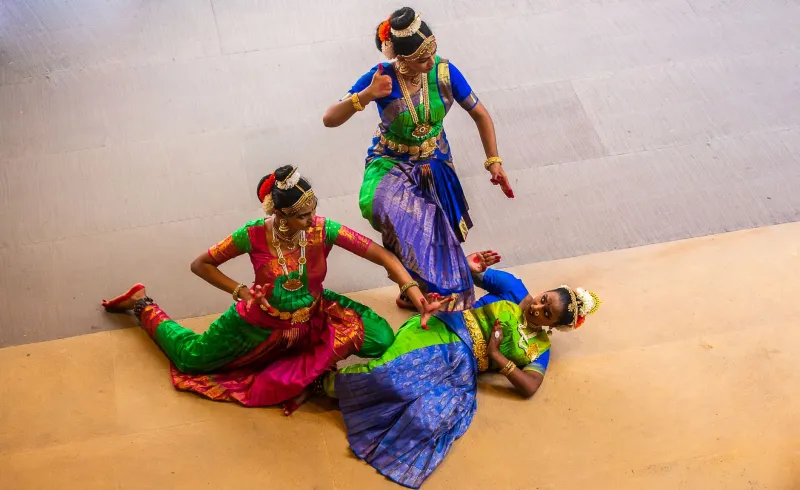
When a dancer executes a Drishti — a precisely directed eye movement — at twenty feet, an audience member can read its emotional content with the intimacy the form requires. At one hundred and fifty feet, that same movement dissolves into the general impression of a face. The mudra, the hand gesture that constitutes a kind of spoken language within the dance, operates similarly. At close range, the difference between a Pataka and a Tripataka is grammatically meaningful. At the back of a two-thousand-seat hall, both become decorative.
The Choreographer's Calculation
Practicing choreographers working at the intersection of Indian classical forms and Western presentational venues are acutely aware of these constraints — and deeply divided about how, or whether, to respond to them.
Some have pursued what might be called an expansionist adaptation: enlarging gesture vocabularies, amplifying facial expression toward something closer to theatrical mime, and restructuring spatial pathways to fill a larger stage footprint. The risk, as several practitioners have noted in conversations with this publication, is that such adaptations can inadvertently shift the form toward spectacle — prioritizing visual impact over the interior, contemplative transmission that makes classical Indian dance distinct from other theatrical traditions.
Others have resisted adaptation altogether, insisting that programming decisions rather than choreographic compromises are the appropriate response. If a form cannot survive scaling, the argument goes, then it should not be scaled. It should be presented in venues commensurate with its design: black-box theaters, university recital halls, intimate cultural centers. The art form's integrity, in this view, is not negotiable.
A third position, perhaps the most intellectually honest, acknowledges that something is always lost in translation — that the question is not whether to compromise but which compromises are acceptable and which are fatal.
What Western Theatrical Conventions Assume
The Western proscenium theater, which remains the dominant venue type for touring dance performance across the United States, was built around a particular set of assumptions about performance. Chief among them is that the audience's role is passive observation from a fixed remove. The fourth wall is a defining convention. Performer and witness are separated not merely spatially but ontologically.
Indian classical performance traditions carry a fundamentally different assumption. The audience is not a passive recipient but an active participant in the generation of rasa. The Natyasastra describes the ideal rasika — the cultivated audience member — as someone whose inner life is awakened and engaged by the performer's offering. This is not metaphor. It is a description of a real dynamic that depends on physical proximity and an absence of the distancing conventions that Western theatrical architecture tends to impose.
The proscenium's picture-frame stage, with its implied separation of worlds, works against this dynamic structurally. So does the darkened house, which severs the performer's ability to read the audience's response and calibrate accordingly — a feedback loop that is essential to classical Indian solo performance in its original contexts.
The Question of Amplification
There is a deeper philosophical question embedded in this practical dilemma, one that extends well beyond logistics. It concerns whether certain art forms are, by their nature, resistant to amplification — and whether that resistance is a limitation or a defining quality.
Indian classical dance, particularly in its solo formats, is an art of interiority made visible. Its power derives not from scale but from precision, not from spectacle but from presence. The Abhinaya — the expressive, narrative dimension of the dance — communicates through increments of facial movement so fine that they require closeness to register. A slight parting of the lips, a barely perceptible shift in the gaze: these are the instruments of the form's most profound moments.
To amplify these through video projection, as some productions have attempted, is to introduce a mediation that subtly changes the nature of what is being transmitted. The audience is no longer in the presence of a body. They are in the presence of an image of a body. The distinction matters enormously in traditions where the live, embodied encounter between performer and witness is itself the point.
Rethinking the Venue Before Rethinking the Form
What emerges from sustained engagement with this question is a case not for choreographic compromise but for curatorial intelligence. American presenting institutions — universities, performing arts centers, cultural organizations — bear significant responsibility for how Indian classical dance is received on these shores. Booking a Bharatanatyam soloist into a two-thousand-seat hall because it is the available venue is not neutral programming. It is a decision with aesthetic and cultural consequences.
A growing number of presenters are beginning to reckon with this. Some have begun programming Indian classical performances in deliberately smaller configurations, accepting reduced ticket revenue in exchange for a more authentic transmission of the work. Others are exploring flexible staging arrangements that bring audiences closer to the performance plane.
These are not radical interventions. They are acts of curatorial respect — an acknowledgment that the venue is not a neutral container but an active participant in the meaning of what happens inside it.
The choreographer's dilemma, ultimately, may not be the choreographer's to solve. The deeper work belongs to the institutions that shape the conditions of presentation — and to the audiences willing to ask, with genuine curiosity, what it would mean to meet an ancient art form on its own terms rather than on ours.