Inhale, Then Move: How Indian Classical Dance Is Restoring the Body to Performers Living Inside Their Screens
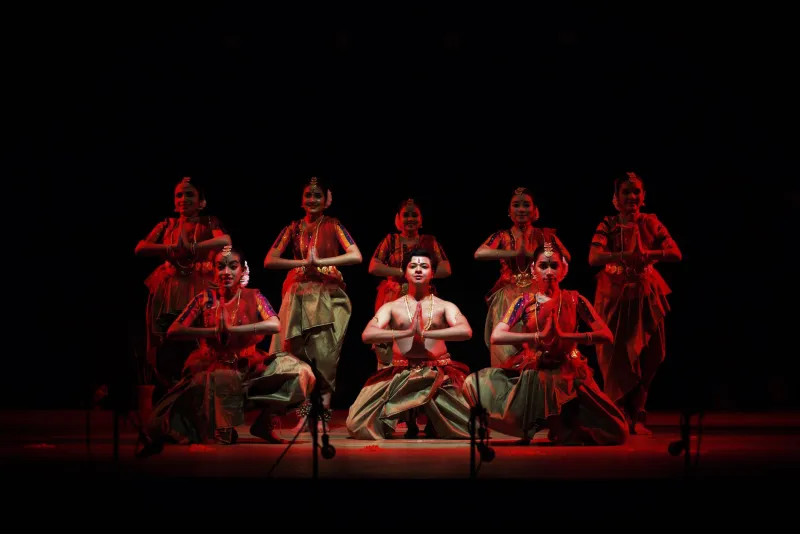
Something has shifted in the rehearsal rooms of American theater conservatories. Alongside the familiar exercises drawn from Stanislavski and Viewpoints, a quieter, older discipline is beginning to appear — one that asks performers not to emote or physicalize, but simply to breathe. Deliberately. Fully. In coordination with the body's most fundamental architecture.
The source of this practice is not a wellness trend or a new performance methodology. It is the foundational breath training embedded in Indian classical dance — a discipline that has, for centuries, understood the body not as an instrument to be deployed but as a living text to be inhabited.
The Crisis Hiding in Plain Sight
Neuroscientists and physical therapists working with performing artists in cities like New York, Los Angeles, and Chicago have begun documenting a phenomenon that, while not entirely new, has accelerated dramatically in the past decade. Clinicians describe it variously as postural collapse syndrome, somatic dissociation, or simply the embodiment deficit — a condition in which the body's relationship to breath, weight, and spatial awareness is progressively eroded by hours spent in screen-forward postures.
For performers, the consequences extend well beyond lower back pain. Shallow breathing compresses the diaphragm, reducing the resonant capacity of the voice. Collapsed chest postures inhibit the expansive physical presence that stage performance demands. Perhaps most significantly, the neurological feedback loops that connect breath to emotional availability — loops that actors and dancers depend upon for authentic expressive work — become attenuated through chronic disuse.
The result, as one New York-based movement therapist described it, is performers who are technically accomplished but physically unavailable. They know what to do with their bodies. They have simply stopped feeling them.
What the Tradition Knew First
The Natyashastra, the ancient Sanskrit treatise that forms the theoretical bedrock of Indian classical performance, does not treat breath as a preliminary warm-up or a secondary concern. It treats breath — prana, the animating life force — as the originating condition of all expressive possibility. Before a hand gesture carries meaning, before a facial expression communicates emotion, before footwork establishes rhythmic dialogue with the musician, breath must be present, intentional, and aligned.
In traditions such as Bharatanatyam, Odissi, and Kuchipudi, this is not metaphysical language. It is technical instruction. Students in rigorous guru-shishya training learn, often before they learn a single adavu or basic unit of movement, how to breathe in a manner that prepares the body for physical articulation. The inhale lifts and organizes the torso. The exhale grounds and releases. The pause between them — what practitioners sometimes describe as the suspension — is where intention gathers before movement begins.
This is the breath before the movement. And it is precisely what is absent in the bodies of performers shaped by years of digital habitation.
From the Studio to the Conservatory
The pathway by which this knowledge has traveled into American performance training is neither linear nor institutionally organized. It has moved, as most significant artistic exchange does, through individual practitioners — dancers trained in Indian classical forms who have found careers in interdisciplinary performance, somatic therapists who encountered the tradition through yoga and pursued it into its deeper origins, and a small but growing number of theater educators who have recognized in classical Indian movement training a rigor and a coherence that Western somatic methodologies often approximate but rarely match.
At several university theater programs, faculty members have begun incorporating elements of Indian classical breath training into foundational movement courses — not as cultural tourism, but as a pedagogically defensible response to a documented problem. The results, while still largely anecdotal, are consistent enough to have generated genuine institutional interest.
Students report that the practice of coordinating breath with intentional physical transition — entering a posture on an inhale, sustaining it through a controlled exhale, releasing on the subsequent breath — produces a quality of physical attention that conventional Western movement training rarely achieves. The body becomes, in the vocabulary of somatic education, inhabited rather than operated.
Anxiety, Presence, and the Measurable Difference
Beyond the rehearsal room, the implications extend into the broader landscape of performer wellness. Performance anxiety, which affects a significant proportion of American actors, musicians, and dancers at some point in their careers, has a well-documented physiological signature: shallow thoracic breathing, elevated cortisol, and a progressive narrowing of perceptual attention. The body, under anxiety, contracts.
The breath practices associated with Indian classical dance training work in precise opposition to this contraction. The deliberate, diaphragmatic breathing that underpins classical dance preparation activates the parasympathetic nervous system, lowering cortisol and expanding the field of perceptual attention. Practitioners describe the effect not as relaxation — the tradition is too rigorous and demanding for that word to be accurate — but as a kind of alert stillness. The body becomes simultaneously grounded and available.
Therapists working at the intersection of somatic practice and performance psychology have begun to recognize this quality as something their clients urgently need and rarely encounter in conventional therapeutic contexts. The ancient framework, it turns out, has practical clinical utility.
The Question of Integrity
Any serious engagement with this territory must also reckon with the question of cultural integrity. Indian classical dance is not a resource to be mined for techniques that serve Western purposes. It is a living tradition with its own internal logic, its own spiritual dimensions, and its own communities of practitioners who have maintained it through historical disruption and institutional neglect.
The educators and therapists who are drawing on these practices most thoughtfully are those who approach them with full acknowledgment of their origins — who situate the breath training within the larger philosophical and aesthetic framework from which it emerges, who direct their students toward primary sources and toward teachers within the tradition, and who resist the temptation to extract technique from context in ways that flatten and distort.
When the engagement is conducted with that degree of care and intellectual honesty, something genuinely valuable becomes possible: not the appropriation of an ancient form, but a cross-cultural dialogue in which the depth and coherence of the Indian classical tradition illuminates the limitations of contemporary Western performance practice.
Before the First Gesture
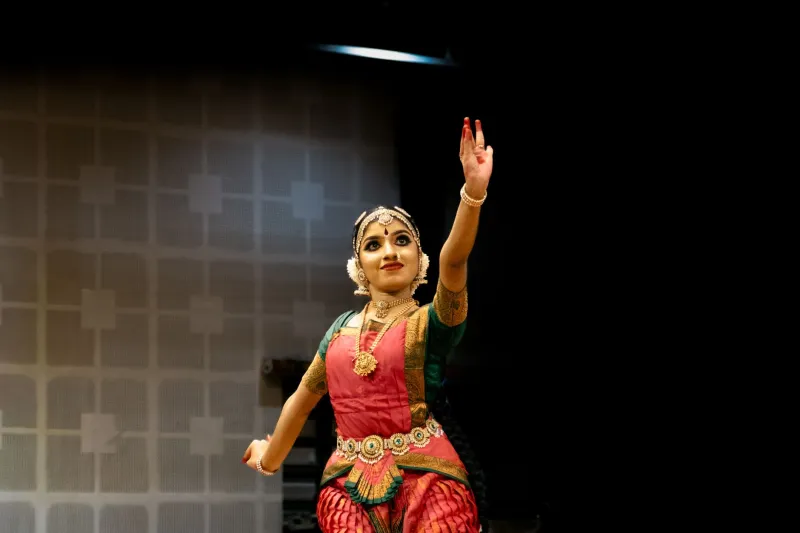
There is a moment, in the opening of a Bharatanatyam performance, before the dancer has executed a single codified movement, when the body simply arrives. The feet find the earth. The spine organizes itself around a central axis. The breath settles into a rhythm that is neither hurried nor effortful. The performer becomes, in the fullest sense of that word, present.
For audiences accustomed to Western performance conventions, this moment can seem puzzling — a pause before the action begins. Within the tradition, it is the action. It is the demonstration that the performer has not merely entered the stage but has entered the body that will move upon it.
In an era when the bodies of performers are increasingly colonized by the postures and habits of screen-based life, that demonstration has become something more than an aesthetic choice. It has become a form of resistance — quiet, ancient, and, as Western performance training is slowly beginning to recognize, indispensable.