The Grammar of Freedom: How Indian Classical Dance's Most Demanding Rules Unlock Its Deepest Creativity
It seems contradictory on its face: that a dance tradition governed by thousands of years of codified rules, precise angular measurements, and mathematical rhythmic cycles could produce some of the most expressive, emotionally unbounded performance on any stage in the world. Yet practitioners and researchers who study Indian classical dance are converging on a surprising conclusion — the strictness is not the obstacle to freedom. It is the mechanism of it.
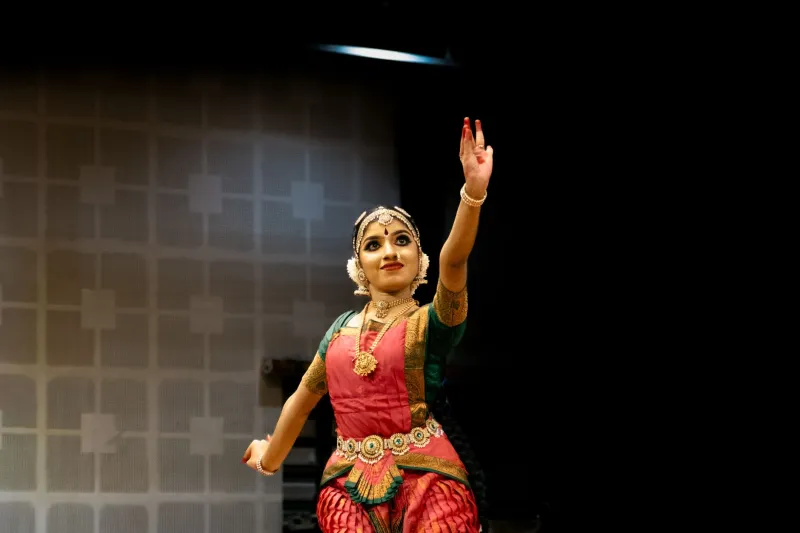
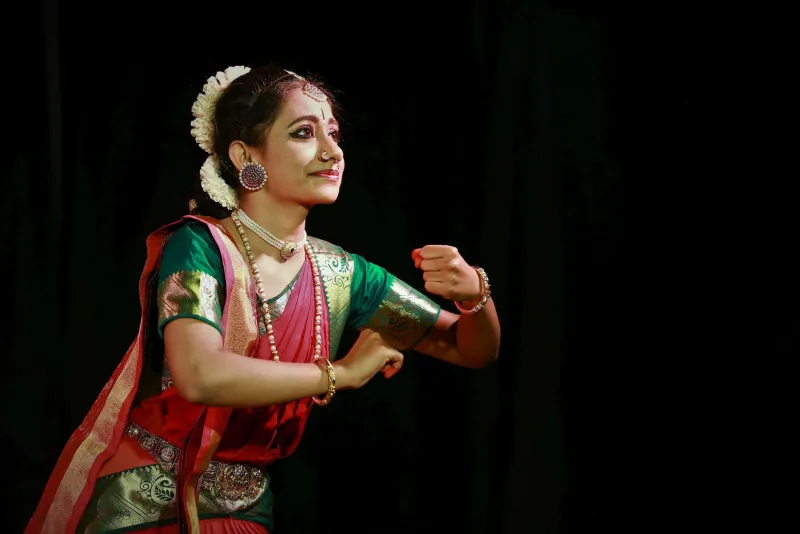
For American audiences encountering Bharatanatyam, Kathak, or Odissi for the first time, the initial impression is often one of overwhelming complexity. The body appears simultaneously rigid and fluid. The hands articulate a vocabulary of dozens of precise gestures. The feet negotiate intricate rhythmic patterns against a musical structure that seems to operate on its own internal logic. The question that naturally arises is: where, inside all of this architecture, does the artist actually live?
The answer, experienced dancers will tell you, is everywhere.
The Architecture of Constraint
The Natyashastra, the ancient Sanskrit treatise that forms the theoretical backbone of Indian classical performance, does not read like an invitation to improvise. It specifies the angle at which a wrist should rotate. It categorizes eye movements into distinct types, each carrying precise expressive meaning. It maps the emotional states — the navarasas — onto specific physical configurations of the face, hands, and torso. For a student entering this tradition, the early years feel less like artistic training and more like the acquisition of a demanding physical language with no shortcuts and no approximations.
This is intentional. The codification that the Natyashastra prescribes, and that guru lineages have transmitted and refined across centuries, functions less like a cage and more like a grammar. A poet working in English does not experience the existence of syntax as a restriction on expression. Quite the opposite: the shared structure of language is precisely what allows meaning to travel between one mind and another. The rules are not the enemy of the poem. They are its precondition.
Kathak dancer and choreographer Manjari Sinha, who trained in the Jaipur gharana before establishing her own teaching practice in Chicago, describes the relationship this way: "When I was young, I resented the repetition. The same footwork sequence, the same hand positions, over and over until they stopped being things I did and became things I simply was. And then one day, in the middle of a performance, I realized I wasn't thinking about any of it — and that was the moment I was actually free."
What Neuroscience Is Beginning to Understand
The phenomenon Sinha describes has a name in cognitive science: automaticity. When a complex motor sequence is practiced to the point of deep procedural encoding, it migrates from the brain's prefrontal cortex — the seat of conscious deliberation — to subcortical structures that operate below the threshold of active thought. The result is that the conscious mind, no longer occupied with executing the technical demands of the movement, becomes available for something else entirely.
Researchers studying expert musicians have documented this effect extensively. A concert pianist performing a Beethoven sonata is not consciously directing each finger; those movements have been absorbed into a kind of embodied automatism. What the conscious mind attends to, instead, is the expressive arc of the phrase, the emotional quality of the moment, the live relationship with the audience. Precision at the technical level, paradoxically, is what purchases freedom at the expressive level.
In Indian classical dance, this dynamic is amplified by the sheer density of the technical system. The body is not managing one stream of complex information but several simultaneously — rhythmic feet, expressive hands, facial abhinaya, spatial geometry, and musical response, all operating in concert. The years of rigorous training are, in a very real neurological sense, the process of offloading each of these streams from conscious control so that the performer can eventually hold them all at once without holding any of them consciously.
The Paradox in Practice
Odissi dancer Priya Vasudevan, who has performed at venues from the Kennedy Center in Washington, D.C., to the Esplanade in Singapore, points to the tradition's treatment of improvisation as the clearest illustration of this paradox. "People assume that a highly codified form leaves no room for spontaneity," she says. "But within a single performance, I am making hundreds of decisions in real time — how long to hold a line, how to respond to what the mridangam player just did, which emotional shade of a gesture to emphasize for this particular audience on this particular night. Those decisions are only possible because the technical foundation is so solid that it doesn't require my attention."
This is distinct from the kind of improvisation familiar to Western contemporary dance, where the absence of prescribed form is itself the creative field. In Indian classical dance, improvisation operates within the form — not against it. The boundaries of the tradition are not walls but pressure. And it is precisely that pressure, practitioners argue, that gives the movement its intensity.
The analogy to the sonnet is instructive here. The Petrarchan sonnet's fourteen lines, its required volta, its metrical constraints — none of these are arbitrary obstacles that a poet must overcome to say something true. They are the very conditions under which certain kinds of truth become sayable. Shakespeare's sonnets are not great despite the form. They are great, in part, because of it.
When the Body Becomes the Instrument
There is a further dimension to this paradox that goes beyond neuroscience and into something closer to phenomenology — the lived experience of inhabiting a highly trained body. Dancers who have spent decades in the tradition describe a quality of physical intelligence that feels, from the inside, less like executing a learned skill and more like thinking with the entire body simultaneously.
Bharatanatyam dancer and teacher Anita Ratnam, whose work has been presented at major American festivals including Jacob's Pillow, has written about this quality as a kind of "somatic fluency" — the point at which the body's technical language becomes so deeply internalized that it ceases to be a language the dancer speaks and becomes, instead, the medium through which the dancer thinks.
This is the endpoint that the tradition's demanding pedagogy is designed to produce. The years of exacting technical training are not preparation for the performance; in a meaningful sense, they are the performance — a decades-long practice of surrendering conscious control until the body itself becomes capable of expression that the deliberate mind could never manufacture.
A Lesson the West Is Starting to Learn
For American artists and educators increasingly drawn to Indian classical forms — whether as performers, choreographers, or scholars — this paradox carries implications that extend well beyond the dance studio. It challenges a deeply held assumption in contemporary Western arts culture: that creative freedom is primarily a function of the removal of constraints, that rules are what artists must overcome rather than what makes artistry possible.
The Indian classical tradition offers a different model — one in which freedom is not the absence of structure but its fullest expression. The dancer who has truly mastered the grammar of the form does not experience its rules as limitations. She experiences them as the precise conditions under which something genuinely unlimited becomes possible.
That is not a paradox, finally. It is a very old and very well-tested truth about what it means to be an artist — one that a two-thousand-year-old treatise understood long before modern neuroscience arrived to confirm it.