Grounded and Unapologetic: How Indian Classical Dance Rewrites the Rules of the Performing Body
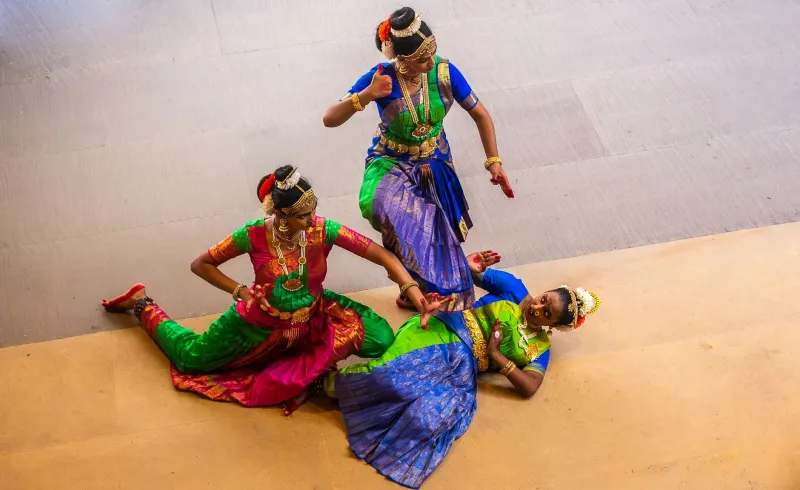
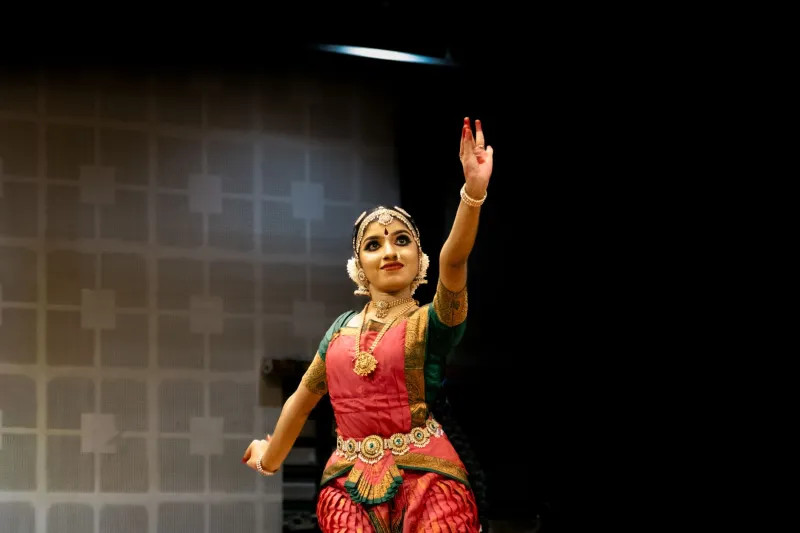
There is a moment in Bharatanatyam training that many students describe as a kind of rupture. After years — sometimes a lifetime — of being told by Western dance teachers to stand tall, pull up, lengthen through the crown of the head, they are asked to bend their knees, widen their stance, lower their center of gravity, and stay there. The instruction sounds simple. The adjustment it demands is anything but.
What is being asked is not merely a technical shift. It is a philosophical one. The aramandi — the foundational half-seated stance from which nearly all Bharatanatyam vocabulary derives — encodes a relationship with the earth that is the precise inverse of the lifted, skyward aspiration that classical ballet has spent three centuries perfecting. Understanding what separates these two postural ideals, and what each one communicates about power, femininity, and bodily authority, reveals something important not just about dance but about the cultural assumptions embedded in what American audiences have been trained to recognize as beautiful.
Two Bodies, Two Philosophies
The aesthetic ideal of classical ballet is, at its core, an ideal of transcendence. The elongated line, the pointed foot, the lifted sternum, the illusion of weightlessness — these are not arbitrary stylistic preferences. They encode a specific cultural value: that the beautiful body is one that appears to have escaped gravity, to have overcome the earthly in favor of the ethereal. The ballerina's pointe shoe is a technology of ascent. Even in contemporary dance forms that have rejected ballet's strictest conventions, the preference for length, lift, and upward spatial orientation remains pervasive in American performance aesthetics.
Indian classical dance begins from a different premise entirely. The earth is not a limitation to be overcome; it is a source of power to be drawn upon. The bent-knee stance of Bharatanatyam, the swaying lateral weight shifts of Odissi, the coiling and uncoiling of the spine in Manipuri — all of these encode a body in active relationship with gravity rather than in flight from it. The performer's weight is not hidden or apologized for. It is the instrument.
This distinction carries implications that extend well beyond aesthetics. The body that is grounded is, in the logic of Indian classical performance, a body with authority. It is not decorative. It is not aspirational in the sense of reaching upward toward an ideal. It is present, rooted, and complete.
The Identity Collision
For dancers who have trained seriously in both traditions, this philosophical divergence is not experienced as an abstract theoretical tension. It is felt in the hip flexors, the lower back, the diaphragm, and the jaw. It is the daily work of inhabiting two bodies that do not share a grammar.
Amara Singh, a performer based in Los Angeles who trained in Kathak from childhood before earning a BFA in contemporary dance from a prestigious conservatory, describes the conflict with precision. "In my contemporary training, I was constantly being told to get out of my hips — to not sit into the weight, to keep the pelvis neutral, to elongate. And in my Kathak training, the hip, the pelvis, the weight — that's where everything lives. I spent years feeling like one of those trainings was secretly wrong. It took me a long time to understand that they were both right, and that they were right about different things."
The conflict is not merely technical. It is, for many dancers of South Asian heritage training in American institutions, also an identity negotiation. The Western aesthetic ideal was not designed with their bodies in mind, and the pressure to conform to it carries a specific cultural weight that white dancers navigating the same technical demands do not experience in the same way.
"When a ballet teacher tells me to lengthen and lift, there's a version of that instruction that is purely technical," Singh continues. "And there's another version that is telling me my natural posture — the posture I grew up with, the posture of my grandmother, the posture of every dancer in my family's tradition — is wrong. Those two versions are not always easy to separate."
The Spine as Cultural Argument
Perhaps no single anatomical feature more clearly marks the boundary between these two aesthetic systems than the treatment of the spine. Western dance, particularly in its classical and neoclassical forms, prizes a spine that is long, vertically organized, and resistant to lateral deviation. The spinal column is a column — upright, architectural, stable.
In Odissi, one of India's oldest surviving classical forms, the spine is explicitly trained to move in the tribhanga — a triple-curve posture in which the head, torso, and hips deflect in opposite directions, creating an S-shaped silhouette that recurs throughout Indian temple sculpture. This is not a relaxed or informal posture. It requires sophisticated muscular coordination and years of training to execute with precision. But it produces a body that, to eyes calibrated to Western norms, can appear asymmetrical, informal, or even incorrectly aligned.
The tribhanga is, in fact, a highly codified aesthetic statement. It encodes a body that is simultaneously grounded and fluid, powerful and graceful, stable and dynamic. The fact that this statement is illegible within Western aesthetic frameworks is not a problem with the statement. It is a problem with the framework.
Quiet Resistance, Visible Authority
American audiences attending Indian classical performances often describe an experience that they struggle to articulate: a sense of presence, of authority, of being in the company of a body that knows exactly what it is and requires nothing from the viewer to confirm it. This quality — which Indian performance theory would identify as a specific dimension of abhinaya, or expressive communication — is not incidental to the aesthetic system. It is its product.
A body trained to draw power from the ground rather than escape it, to express authority through rootedness rather than elevation, communicates something that the Western performance aesthetic, for all its beauty, does not: that the earth itself is a source of dignity.
In a cultural moment when questions of whose bodies are centered, whose movement vocabularies are valued, and whose aesthetic standards are treated as universal are being asked with new urgency across American arts institutions, this is not a minor observation. It is, in its quiet way, a political one.
The grounded body does not ask permission to be present. It simply is.