Sacred Floors and Fragrant Air: Inside the Sensory World of America's Indian Classical Dance Studios
Walk into a well-appointed yoga studio in Brooklyn or a boutique fitness center in Los Angeles and you will encounter a curated environment: diffused lighting calibrated for calm, scents engineered to signal relaxation, surfaces chosen for their photogenic neutrality. Everything has been optimized. The question of whether optimization actually produces healing is one that the Indian classical dance studio—often overlooked in American wellness conversations—answers with quiet authority.
These spaces are not optimized in any contemporary commercial sense. They are layered, accumulated, and in many cases deliberately archaic. And that, practitioners and researchers increasingly suggest, may be precisely the point.
The Sensory Architecture of a Traditional Space
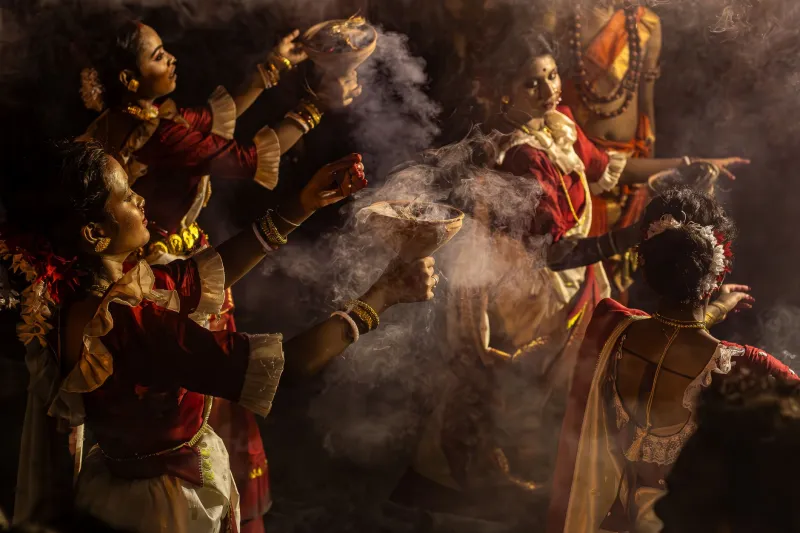
The traditional dance studio within the Indian classical context—sometimes called an arangetram preparation space, sometimes simply the kalari or practice hall—carries a sensory signature unlike anything in the Western fitness lexicon. Incense is not decorative. It marks the beginning of practice as a transition from ordinary time into heightened attention, a ritual boundary that the nervous system learns, over years of training, to recognize and respond to. The smoke rising from a stick of sandalwood or camphor is not aromatherapy in the commercial sense; it is a cue embedded in a tradition that understands the body as a receiver of environmental information.
The smell of physical effort—honest sweat from bodies working at the edges of their capacity—coexists with these ritual aromas in a way that would be considered a design failure in a Western wellness context. In the Indian classical studio, that coexistence is not a failure of ventilation. It is a kind of truth-telling: this is a space where sacred intention and physical rigor are not opposites. They are the same project.
Acoustics, too, operate differently. Many studios retain the resonance of high ceilings and hard floors, allowing the sound of nattuvangam—the rhythmic syllables called by the teacher—to fill the room without electronic amplification. The tattu kazhi, or wooden block struck to mark rhythm, produces a sound that carries a particular frequency through bare floors and into the soles of the feet. Students do not merely hear rhythm in these spaces; they feel it as vibration rising through the body from the ground up.
What Happens to American Practitioners
For many American students encountering an Indian classical studio for the first time, the initial response is disorientation. The spatial arrangement may seem informal by Western standards: photographs of deities alongside photographs of legendary dancers, flowers left at the base of a small altar, a teacher who does not introduce herself by credentials but begins, simply, by demonstrating. There is no intake form. There is no liability waiver prominently displayed. The studio asks for a different kind of trust.
This disorientation, several practitioners report, gives way to something unexpected. "I kept waiting for the space to tell me what to do," said one American student who began Bharatanatyam training in her mid-thirties at a studio in the Chicago suburbs. "In every other fitness environment I'd been in, the room itself was giving me instructions—screens, arrows, numbered stations. Here, I had to actually pay attention to a human being. It was almost overwhelming at first."
The shift from environmental instruction to human transmission is not incidental. It is structural. The Indian classical studio is designed—through centuries of accumulated pedagogical wisdom—to direct attention toward the teacher's body and voice as the primary source of knowledge. This orientation has consequences that extend well beyond dance technique.
The Therapeutic Logic of Imperfection
Western wellness research has begun to examine what environmental psychologists call "restorative environments"—spaces that support psychological recovery from directed attention fatigue. The characteristics identified in this literature include the presence of natural or complex stimuli, a sense of fascination without demand, and a feeling of coherent meaning or purpose within the space. The traditional Indian classical studio, without any reference to this research framework, embodies all three qualities.
The layered sensory environment—incense, rhythm, physical effort, devotional imagery, the sound of a teacher's voice modulating between instruction and demonstration—provides what researchers describe as "soft fascination," the kind of gentle engagement that allows the prefrontal cortex to rest while the body remains active. This is a fundamentally different physiological state from the vigilant attention demanded by a high-intensity interval training class or the dissociated passivity of a screen-mediated workout.
The non-optimized quality of these spaces may also communicate something important about the nature of the practice itself. When a studio is not selling you an experience—when it does not need to persuade you of its value through aesthetic curation—the implicit message is that the practice is sufficient. The tradition is enough. This is a form of environmental honesty that the wellness industry, with its considerable investment in manufactured atmosphere, rarely achieves.
Preservation and Presence
There is a tension worth acknowledging here. As Indian classical dance studios expand their reach across American cities and suburbs, some have adapted their environments to meet the expectations of a wellness-conscious clientele. Cleaner lines, softer lighting, the removal of devotional imagery to avoid the appearance of religious imposition—these are understandable accommodations, and they are not without value in making the tradition accessible to a broader audience.
But something is also lost in that accommodation. The specific sensory signature of a traditional studio is not merely aesthetic preference; it is the accumulated environmental wisdom of a tradition that understood the body as inseparable from its surroundings. When the incense is replaced by a neutral diffuser blend, when the altar is removed to a back room, when the resonant wood floor is covered with sprung panels designed for impact absorption, the space becomes more comfortable and less transformative.
This is not an argument for the preservation of discomfort as an end in itself. It is an observation that the traditional Indian classical studio, in its full sensory complexity, offers something that its modernized counterpart cannot fully replicate: an environment that has been shaped by the same intelligence that shaped the art form. The smell of sweat and incense, coexisting without apology, is not an oversight. It is a philosophy made atmospheric.