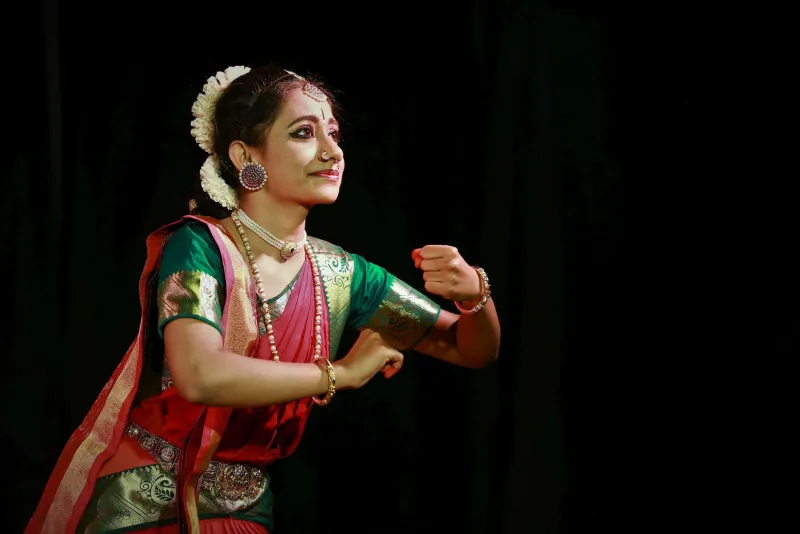
What the Body Knows and the Page Cannot Hold: The Disappearing Knowledge of Indian Classical Dance
In 1952, Rudolf Benesh developed a notation system that could represent ballet choreography with sufficient precision to reconstruct a work decades after its creation. The Royal Ballet uses Benesh notation today. Labanotation, developed earlier in the twentieth century, serves a similar function across multiple Western dance traditions. These systems share a common assumption: that movement can be adequately represented in a two-dimensional symbolic language, and that such representation constitutes a form of preservation.
Indian classical dance, across its major forms—Bharatanatyam, Kathak, Odissi, Manipuri, Kuchipudi, and others—has never developed an equivalent system. This is not because the tradition lacked sophistication. The Natyashastra, composed between roughly 200 BCE and 200 CE, contains some of the most elaborate technical documentation of performance practice produced anywhere in the ancient world. The absence of dance notation is not a gap. It is a position.
The Epistemology of Embodied Transmission
To understand why Indian classical dance resists notation, it is necessary to understand what the tradition believes knowledge to be. In the guru-shishya framework—the teacher-student relationship that has governed transmission for millennia—knowledge is not information. It is transformation. What the student receives from the teacher is not a set of instructions that could, in principle, be written down and followed independently. It is a quality of understanding that exists only in the relationship between a knowing body and a learning one.
This distinction has practical implications that notation systems cannot address. The precise angle of a wrist in a given mudra, for instance, is not a fixed quantity. It varies according to the dancer's proportions, the specific musical phrase being interpreted, the emotional quality being expressed, and the accumulated judgment of a teacher who has spent decades developing the capacity to perceive and correct these variables simultaneously. A notation system can record an approximate position. It cannot record the living intelligence that determines when that position is correct.
The tradition has historically regarded this limitation not as a deficiency of notation but as a feature of the knowledge itself. What cannot be transmitted through a page is transmitted through years of watching, imitating, correcting, and gradually internalizing. The body becomes the archive. The dancer carries what no document can hold.
What Is Lost When a Lineage Ends
The consequences of this approach become most visible when a lineage breaks. When a teacher dies without having transmitted the full scope of her knowledge—whether through the absence of dedicated students, through illness, through the disruptions of colonial history or economic necessity—what she carried disappears with her. There is no score to consult, no notation to reconstruct from. The knowledge is simply gone.
The twentieth century produced numerous such losses in Indian classical dance. The consolidation and revival movements of the 1930s and beyond, while restoring certain forms to visibility, also standardized them in ways that obscured regional variations, idiosyncratic stylistic lineages, and interpretive traditions that existed outside the mainstream. Some of what was recovered was genuine revival. Some of it was reconstruction based on incomplete information—and the difference between the two is not always visible in the finished performance.
In the American context, where Indian classical dance communities are smaller and more geographically dispersed, the risk of lineage interruption is acute. A teacher who retires or relocates may leave students who have received years of training but not the complete transmission that would allow them, in turn, to teach at the highest level. The knowledge does not disappear dramatically; it thins, gradually, across generations.
The Digital Archive and Its Discontents
The impulse to address this vulnerability through technology is understandable and, in some respects, valuable. Video documentation of master teachers, motion-capture analysis of advanced practitioners, and oral history projects that record pedagogical commentary alongside performance footage all contribute to a record that is genuinely richer than what previous generations possessed.
But the tradition itself raises a question that the archival impulse tends to sidestep: whether a recording of a performance is a record of the knowledge or merely a record of one of its effects. A video of a master Bharatanatyam dancer performing an alarippu captures the movement as it appeared on a particular day, in a particular body, in response to a particular musical interpretation. It does not capture the reasoning behind each choice, the corrections that preceded the performance, the understanding that made those choices possible, or the capacity to transmit that understanding to another body.
There is also a subtler concern. When a tradition knows that it is being recorded, the act of recording changes the tradition. Performances calibrated for camera documentation differ from performances shaped by the intimate dynamics of a live gathering. Pedagogical demonstrations given for archival purposes differ from the unguarded transmission that occurs when a teacher is simply teaching. The camera is not a neutral observer; it is a presence that the tradition must accommodate, and accommodation has costs.
Preservation as Interpretation
Perhaps the most honest framing of this dilemma is to recognize that all preservation is interpretation. Ballet's notation systems do not preserve choreography in any absolute sense; they preserve a notator's interpretation of what she observed, filtered through the symbolic limitations of the notation language and the conceptual assumptions built into it. Reconstructions from notation are themselves acts of interpretation, shaped by the knowledge and judgment of the reconstructing dancer.
Indian classical dance's embodied transmission is also interpretive at every stage—but it foregrounds that interpretive quality rather than concealing it behind a documentary facade. The student who learns from a teacher receives not a fixed text but a living interpretation, and understands that what she is receiving is precisely that. The tradition is honest about its own mutability in a way that notation-based systems, with their implication of fixity, are not.
What this means for the future is not that documentation efforts should be abandoned. It means that they should be pursued with a clear understanding of what they can and cannot preserve—and with genuine humility about the difference between saving a record of a tradition and sustaining the tradition itself. The former requires hard drives and institutional funding. The latter requires teachers, students, and the years of patient, embodied attention that no technology has yet learned to replace.