Neither Here Nor There, Yet Fully Both: How Second-Generation Indian-American Dancers Are Reshaping Classical Authority
Authenticity is a word that carries weight in the world of Indian classical dance—sometimes so much weight that it crushes the very people it purports to protect. For decades, the question of who could legitimately claim authority over these forms in the American context has been answered, implicitly or explicitly, by pointing toward India: toward teachers trained there, toward lineages rooted there, toward a geography that functions as a kind of credential. The second generation of Indian-American classical dancers is now asking, with increasing directness, whether that answer was ever sufficient—and whether it remains useful at all.
The Particular Position
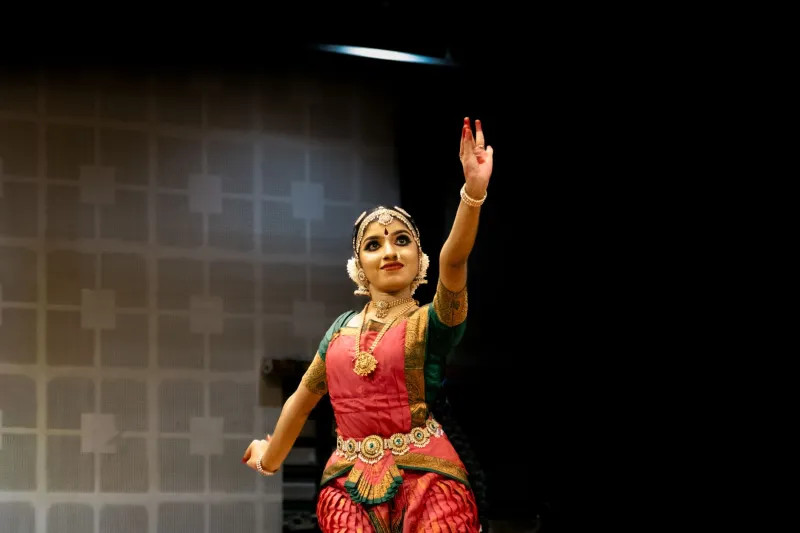
The children of Indian immigrants who trained in classical forms occupy an unusual cultural location. They have, in many cases, studied with the same rigor demanded of students in Chennai or Kolkata. They have sat through years of corrections, endured the physical demands of technique acquisition, learned Sanskrit invocations by ear, and performed in temples and community halls before audiences who knew the tradition deeply enough to recognize even minor errors. Their training is, by any technical measure, legitimate.
And yet they have also grown up in American schools, absorbed American cultural references, navigated the particular social experience of being visibly South Asian in a country that has rarely known what to do with that visibility. They have felt the distance between their home environments and their school environments, sometimes acutely. They have, in many instances, experienced their classical training not as a connection to a living culture but as a form of cultural maintenance—an effort to preserve something that their parents feared was slipping away.
This dual formation produces a perspective that is neither fully diasporic nor fully rooted in the subcontinent. It is something more genuinely new: an American relationship to an Indian classical tradition, built on real technical knowledge and real cultural complexity in equal measure.
The Gatekeeping Problem
Within Indian classical dance communities in the United States, gatekeeping takes several recognizable forms. There is the question of lineage—which guru a dancer studied with, and whether that guru studied with someone of sufficient renown. There is the question of regional authority—whether a dancer trained in the geographic heartland of a given form, or whether their training occurred in diaspora. And there is, often unspoken but consistently present, the question of cultural belonging: whether a dancer's relationship to the tradition is felt or merely performed.
For second-generation dancers, this last question arrives with particular sharpness. They are frequently assessed by two audiences whose standards do not align. Indian-born community members may scrutinize their relationship to the tradition's devotional or cultural dimensions, questioning whether American upbringing has produced a dancer who understands the form from the inside. American audiences, meanwhile, may project a different kind of essentialism—assuming that Indian heritage guarantees authentic knowledge, without recognizing that heritage and training are distinct categories.
Navigating these simultaneous and contradictory expectations has produced, in some second-generation dancers, a kind of strategic code-switching. Others have responded with something more confrontational: a direct challenge to the premise that authenticity can be adjudicated by anyone other than the practitioner and her tradition.
New Interpretations, New Questions
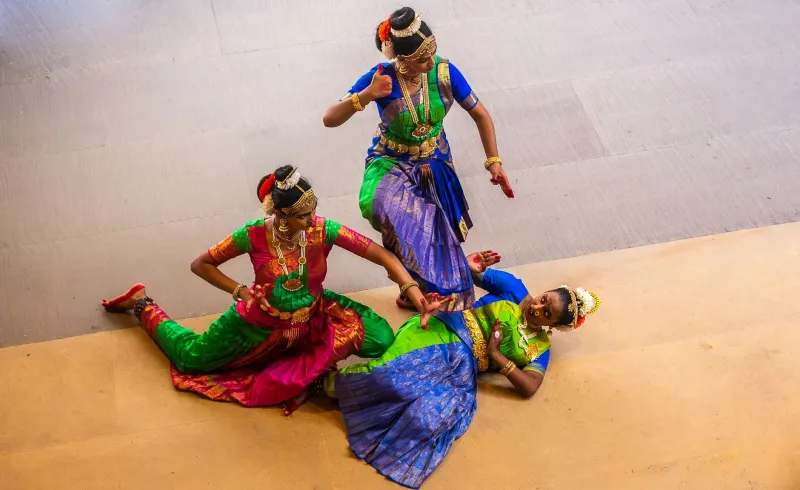
The choreographic work emerging from this generation reflects its position. Pieces that set classical Bharatanatyam vocabulary against narratives drawn from the immigrant American experience—the TSA checkpoint, the hyphenated identity, the grandmother's kitchen as a site of cultural transmission—are not departures from the tradition so much as applications of it. The classical forms have always been vehicles for storytelling that engages the full complexity of human experience. The second generation is extending that capacity into territory that the tradition's originators could not have mapped.
This extension is not universally welcomed. Some teachers and senior practitioners argue that the classical forms carry specific cultural and spiritual content that cannot be separated from their aesthetic structures—that to use Bharatanatyam's vocabulary to tell a story about airport security is to misunderstand what the vocabulary is for. This is a serious argument, and it deserves serious engagement rather than dismissal.
But the second generation offers a counter-argument that is equally serious: that the tradition's vitality has always depended on its capacity to speak to the living circumstances of its practitioners. The devadasi performers who originated many of these forms were not preserving a museum artifact; they were engaging, through movement and music, with the full weight of their own historical moment. To freeze the tradition at any particular historical point—even a point that feels authoritative—is to do something the tradition itself never did.
What Cultural Authority Actually Means
The more productive question, perhaps, is not who owns the tradition but what it means to be genuinely responsible to it. Responsibility, in this framing, requires technical knowledge—years of embodied training that cannot be shortcut or simulated. It requires engagement with the tradition's philosophical and aesthetic dimensions, not as decoration but as structural understanding. And it requires honesty about one's own position within the tradition: what one brings to it, what one takes from it, and what one is still learning.
By these standards, many second-generation Indian-American dancers are not on the margins of the tradition. They are among its most thoughtful contemporary stewards—precisely because their position has forced them to think carefully about questions that more settled practitioners can afford to leave unexamined.
The future of Indian classical dance in America will not be determined by the resolution of authenticity debates. It will be shaped by the quality of the work being made and transmitted, and by the integrity with which practitioners engage the tradition's demands. On those grounds, the second generation has more than earned its place at the center of the conversation.